What is PACT?
PACT (Partnership for Carbon Transparency) is a global initiative launched in 2020 and hosted by the World Business Council for Sustainable Development (WBCSD) that provides a standardised framework for calculating and exchanging product carbon footprints (PCFs) across value chains.
By establishing consistent calculation rules and data quality criteria, PACT helps increase transparency across value chains, eliminates confusion around PCF methodologies, and sets a standard for high-quality, exchangeable emissions data.
For suppliers, this means being able to demonstrate data credibility, meet customer requirements with standardised PCFs, and differentiate their products in an increasingly carbon-conscious market.
Why PACT matters
Up to 90% of a company's emissions come from purchased goods and services (scope 3), yet inconsistent methodologies, non-comparable PCFs, and limited data quality make effective action difficult across the supply chain. PACT solves this by enabling the consistent calculation and exchange of supplier-specific, cradle-to-gate PCF data, replacing generic industry averages with high-quality primary data.
How PACT works
PACT is built on three strategic pillars:
1. Methodology and standards: Harmonised PCF calculation rules based on the GHG Protocol and ISO standards, with standardised definitions for system boundaries, allocation, and cut-off criteria.
2. Data quality and governance: Robust Data Quality Indicators (DQIs) covering technological, geographical, and temporal representativeness, completeness, and reliability.
3. Data exchange (PACT Network): An open, global network of interoperable solutions for secure peer-to-peer exchange of product emissions data across all industries and value chains.
Why companies need PACT
Regulatory compliance
With emerging frameworks taking effect, companies need accurate value chain emissions data to remain compliant, financially viable, and competitive.
Better data for better decisions
PACT standardises PCF creation and exchange by constraining methodological choices and requiring consistent reporting with explicit data quality (primary vs. secondary) disclosures.
Meeting science-based targets
Companies need reliable scope 3 data to track real year-on-year decarbonisation progress. PACT provides the structured, transparent data-quality framework to reduce uncertainty and demonstrate credible progress.
Scalability and interoperability
PACT enables automated, scalable digital PCF workflows across tools, industries, and supply networks, making cross-company collaboration far more efficient.
Competitive advantage
Greater transparency can positively influence the bottom line, mitigate climate-related risk, and drive competitive advantages.
Who is using PACT?
Over 2,500 companies have adopted PACT globally, and more than 40 solution providers across 14 countries have become "PACT Conformant." Major adopters include Unilever, P&G, BASF, Dow, Toyota, BMW, SAP, and IBM.
ClimatePartner and PACT
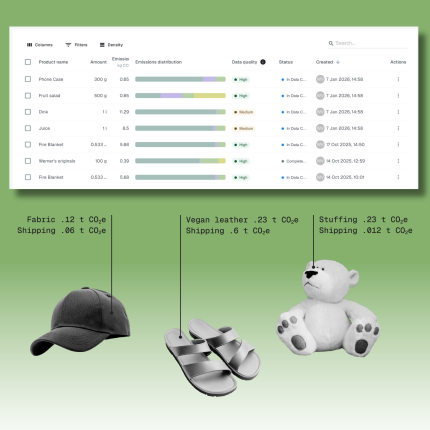
With the launch of the automated PCF tool, ClimatePartner enables suppliers to cost-effectively deliver PCFs at mass-SKU level for cradle-to-gate emissions. The data quality scoring is based on the PACT framework.
See how the PCF software works.
Automated PCFs
Get PCF insights in minutes, not weeks with automated product footprints. You answer customer requests faster, strengthen tenders with credible numbers, and focus reduction efforts where they matter most. Product footprints help you turn product-level emission insights into a commercial advantage – without the time and cost of manual footprints.
Find out more