Bayer and Perdue: Scaling regenerative agriculture together
Scaling regenerative agriculture through cross-value-chain collaboration
Food production is both a major driver of climate change and one of the sectors most vulnerable to its effects. Approximately 12% of global greenhouse gas emissions are associated with agriculture. These emissions contribute to global warming, exacerbating severe weather patterns such as unexpected rainfall and droughts, which can harm farmland and disrupt global food production.
In light of these challenges, companies are pursuing transformative changes to reduce emissions and mitigate the impacts of climate change. By forming partnerships across their supply chains, companies can achieve greater scale and impact.
Perdue Farms, a leading U.S. producer of poultry, grain, oils, and feed, saw an opportunity to transform its supply chain to mitigate climate impacts. Perdue collaborated with Bayer’s Ecosystem Services, a global business unit of its Crop Science division focused on developing sustainability solutions for companies with science-based targets. Together, Bayer and Perdue introduced regenerative agriculture practices to the farms that supply them with grain. ClimatePartner was retained to calculate the carbon footprint of two key Perdue products produced with the regenerative grain: edible soybean oil and ready-to-eat chicken breast.
Bayer and Perdue trusted ClimatePartner to guide them through the data collection process and design a sound methodology to evaluate the program’s results. The collaboration aimed to quantify emissions and removals of regenerative practices using primary data across Perdue’s value chain, and then to develop credible and transparent reports to communicate the results to their customers.
The Bayer and Perdue partnership
In September 2022, Bayer and Perdue launched a collaboration to decarbonize their food supply chain through regenerative agriculture. By implementing cover crops and no-till farming, they aimed to incentivize farmers to sequester carbon in the soil and share the results with Perdue’s customers.
Conventional farming relies on machinery to till fields, breaking up the soil for easier planting. However, this process disrupts the delicate system of roots, fungi, and organic matter that enriches the soil and sequesters carbon. Employing regenerative agriculture practices like no-till farming preserves soil structure and can reduce the release of carbon dioxide from the soil.
From field to footprint: Our methodology
For the 2023 growing season, growers enrolled approximately 54,000 acres of farmland in the program, committing to regenerative practices such as cover crops and no-till and documenting their activities. Bayer deployed its ForGround platform to the growers to collect data on crop rotations, yield, growing practices, and fertilizer use. Meanwhile, Perdue collected primary data across its vertically integrated operations. This access to primary data was key to reflecting regenerative agriculture in the results.
After verifying accuracy and completeness, ClimatePartner used the data to calculate two product carbon footprints, representing the products’ entire lifecycle, from raw materials to production, transportation, use, and disposal. Emissions and removals from regenerative farming were analyzed following Forest, Land and Agriculture (FLAG) guidance. The results were documented in ISO 14067 reports that underwent third-party verification.
The benefits of primary data
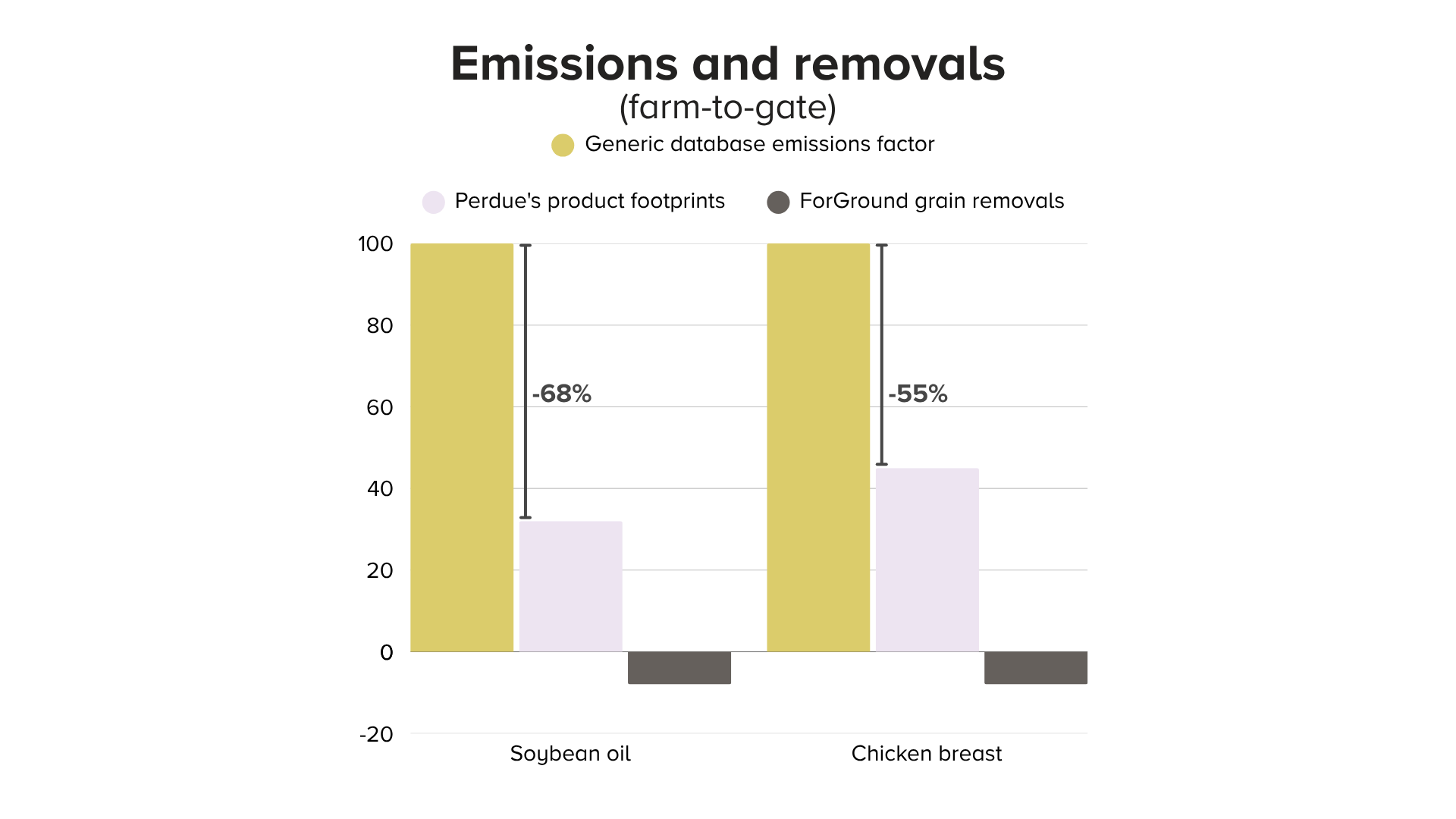
The carbon footprints for Perdue’s soybean oil and chicken breast products were calculated for greenhouse gas emissions, both emitted and removed, throughout the products’ lifecycle. For the edible soybean oil product, removals amounted to 26% of the product’s footprint (farm to gate). For Perdue’s chicken breast, the removals amounted to 18% of the product footprint (farm to grave). Results are based on a single growing season.
Primary data also made the results considerably more accurate. The calculated footprint for soybean oil was 68% lower than the value based on a generic database emission factor, and about 55% lower for chicken (farm to gate).
These results give Perdue's customers more accurate data for their own carbon accounting.
What the results mean for the value chain
By promoting regenerative farming, Bayer and Perdue not only showcase their climate action efforts to customers but also differentiate their products in the market.
This project has helped build a strong business case for growers and suppliers to adopt regenerative agriculture practices, reducing emissions and restoring land for better crop production. Perdue can now provide high-quality emissions data to customers, improving the ease and accuracy of their own carbon footprint calculations. Additionally, Perdue's primary data help customers calculate their scope 3 emissions more accurately.
By combining Bayer's technology, Perdue's operational data, and ClimatePartner's carbon accounting expertise, the project showed how emissions and removals from regenerative agriculture can be calculated along the food value chain.
"Strong partnerships across the value chain are essential. Through our collaboration with Bayer and the ForGround platform, we empower farmers to adopt regenerative agriculture practices that enhance soil health and sequester carbon. Beyond the farmgate, ClimatePartner plays a critical role in measuring our carbon footprint according to international standards, continuously guiding Perdue on how to improve data quality in each step of the supply chain."