What is the EU PPWR?
The PPWR (Packaging and Packaging Waste Regulation) is a comprehensive EU regulation (Regulation (EU) 2025/40) that sets binding rules for all packaging placed on the European market. Its goal is to reduce packaging waste, promote a circular economy, and minimise the environmental impact of packaging across its entire lifecycle.
Adopted in December 2024, the PPWR replaces the former EU Packaging and Packaging Waste Directive (94/62/EC) and applies directly across all EU member states from August 2026.
Why was the PPWR introduced?
Packaging waste in the EU has been growing faster than the economy. Currently, 40% of plastics and 50% of paper used in the EU go into packaging, generating approximately 177 kg of packaging waste per person per year. Reuse rates have declined over the past decade, and packaging waste accounts for around half of all marine litter.
The PPWR was introduced to reverse these trends and create a harmonised, enforceable regulatory framework across Europe.
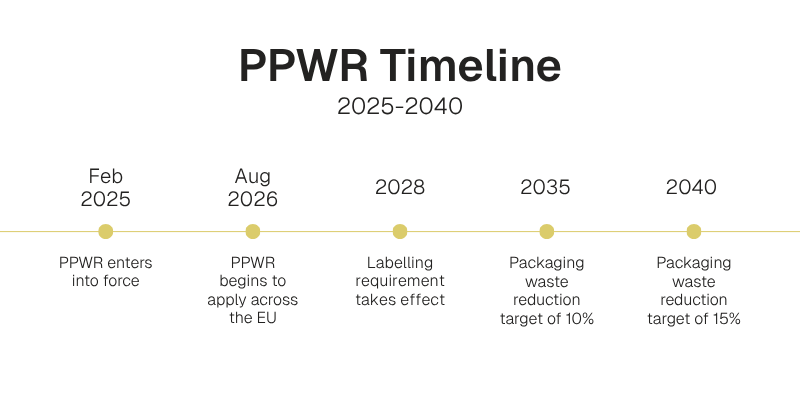
PPWR timeline: When does it apply?
- Feb 2025: PPWR enters into force
- Aug 2026: PPWR begins to apply across the EU
- 2028: Labelling requirements takes effect
- 2030: Recyclability, recycled content targets, minimisation rules, reuse quotas, and certain single-use packaging bans apply
- 2035: Packaging waste reduction target of 10%
- 2040: Packaging waste reduction target of 15%; higher recycled content thresholds
Who does the PPWR affect?
The PPWR applies to all companies that manufacture, import, distribute, or place packaging on the EU market regardless of company size or where the business is headquartered. This includes e-commerce businesses, direct-to-consumer brands, and online marketplaces. Micro-enterprises will be subject to lighter rules.
What are the key requirements of the PPWR?
The PPWR introduces several obligations for businesses:
Recyclability
By 2030, all packaging placed on the EU market must be recyclable. Design-for-recycling (D4R) criteria will be established to ensure packaging can be effectively collected, sorted, and recycled at scale.
Minimum recycled content
The regulation sets mandatory minimum recycled content targets for plastic packaging, with thresholds increasing from 2030 to 2040.
Packaging minimisation
From 2030, packaging must be reduced to the minimum necessary to ensure product safety, hygiene, and logistics. Excessive void space and unnecessarily large packaging will no longer be permitted.
Compostability
Certain packaging types (e.g. tea and coffee bags, stickers on fruits and vegetables) must be compostable under industrially controlled conditions.
Labelling
New labelling requirements will apply, including standardised material composition information and digital marking via QR codes.
Restrictions and bans
Specific single-use packaging formats will be banned from 2030, building on the EU Single-Use Plastics Directive.
Reuse and refill targets
The PPWR introduces binding reuse quotas for transport and sales packaging from 2030; the first EU-wide reuse targets for packaging.
Extended Producer Responsibility (EPR)
EPR fee modulation will incentivise sustainable packaging design, with fees linked to recyclability and recycled content.
How does the PPWR relate to carbon emissions?
Packaging is a significant source of carbon emissions, from raw material extraction and production to transportation and end-of-life disposal. The PPWR's push toward recyclability, recycled content, and waste reduction directly supports lower carbon footprints across product lifecycles.
For companies looking to understand and reduce the climate impact of their packaging, calculating a Product Carbon Footprint (PCF) is a critical first step. A PCF quantifies the greenhouse gas emissions associated with a product, including its packaging, across the product’s lifecycle: raw materials, production, transportation, disposal.
By calculating the carbon footprint of products, businesses can identify emission hotspots, make informed decisions about packaging materials and design, and demonstrate progress toward climate targets.
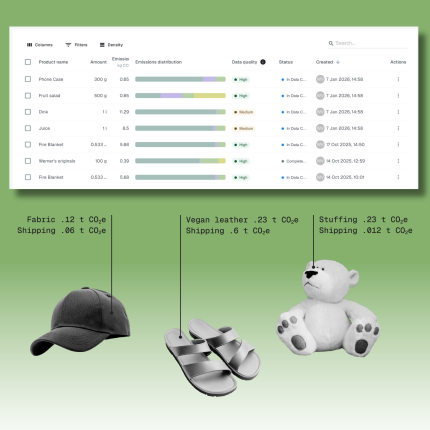
Automated PCFs
Get PCF insights in minutes, not weeks with automated product footprints. You answer customer requests faster, strengthen tenders with credible numbers, and focus reduction efforts where they matter most. Product footprints help you turn product-level emission insights into a commercial advantage – without the time and cost of manual footprints.
Find out more