Cradle-to-gate vs. cradle-to-grave: What’s the difference and which do you need?
April 13, 2026Every product tells a carbon story: How much of it are you calculating?
When companies calculate a Product Carbon Footprint (PCF), one of the first, and most consequential, decisions they make is where to draw the line. That line is called the system boundary, and it determines which stages of a product's life cycle are included in the calculation.
Two terms come up again and again: cradle-to-gate and cradle-to-grave. They look and sound similar, but they serve different purposes, unlock different outcomes, and carry different levels of complexity. Understanding the distinction is essential for any company serious about product-level climate action.
What is cradle-to-gate?
Cradle-to-gate covers a product's journey from raw material extraction (the "cradle") to the point it leaves the factory (the "gate"). It includes:
- Raw material acquisition and processing: Sourcing and preparing the inputs that go into the product
- Manufacturing and assembly: The energy, processes, and waste involved in production
- Packaging: Materials and logistics within the production facility
- What it does not include: Distribution to customers, how the product is used, or what happens to it at the end of its life
By focusing on these upstream stages, cradle-to-gate captures what's often called the embodied carbon of a product: the emissions baked into it before it ever reaches a customer.
What is cradle-to-grave?
Cradle-to-grave extends the boundary to cover the product's entire life cycle. In addition to everything in cradle-to-gate, it includes:
- Distribution: Outbound logistics, warehousing, and retail
- Use phase: The energy and fuel consumed while the product is being used
- End of life: Disposal, recycling, incineration, or landfill
This is the most comprehensive system boundary available, revealing downstream impacts that cradle-to-gate misses. For some products, those downstream impacts are significant: a cotton T-shirt, for example, may generate most of its carbon footprint during the use phase (washing and drying) rather than in manufacturing. Products that require electricity, fuel, or heating to function (appliances, vehicles, electronics) can have use-phase emissions that dwarf their production footprint.
Cradle-to-gate vs. cradle-to-grave: When do you need which?
The right system boundary depends on your goals, your audience, and the regulatory landscape you operate in.
When to use cradle-to-gate
Cradle-to-gate is the right starting point when:
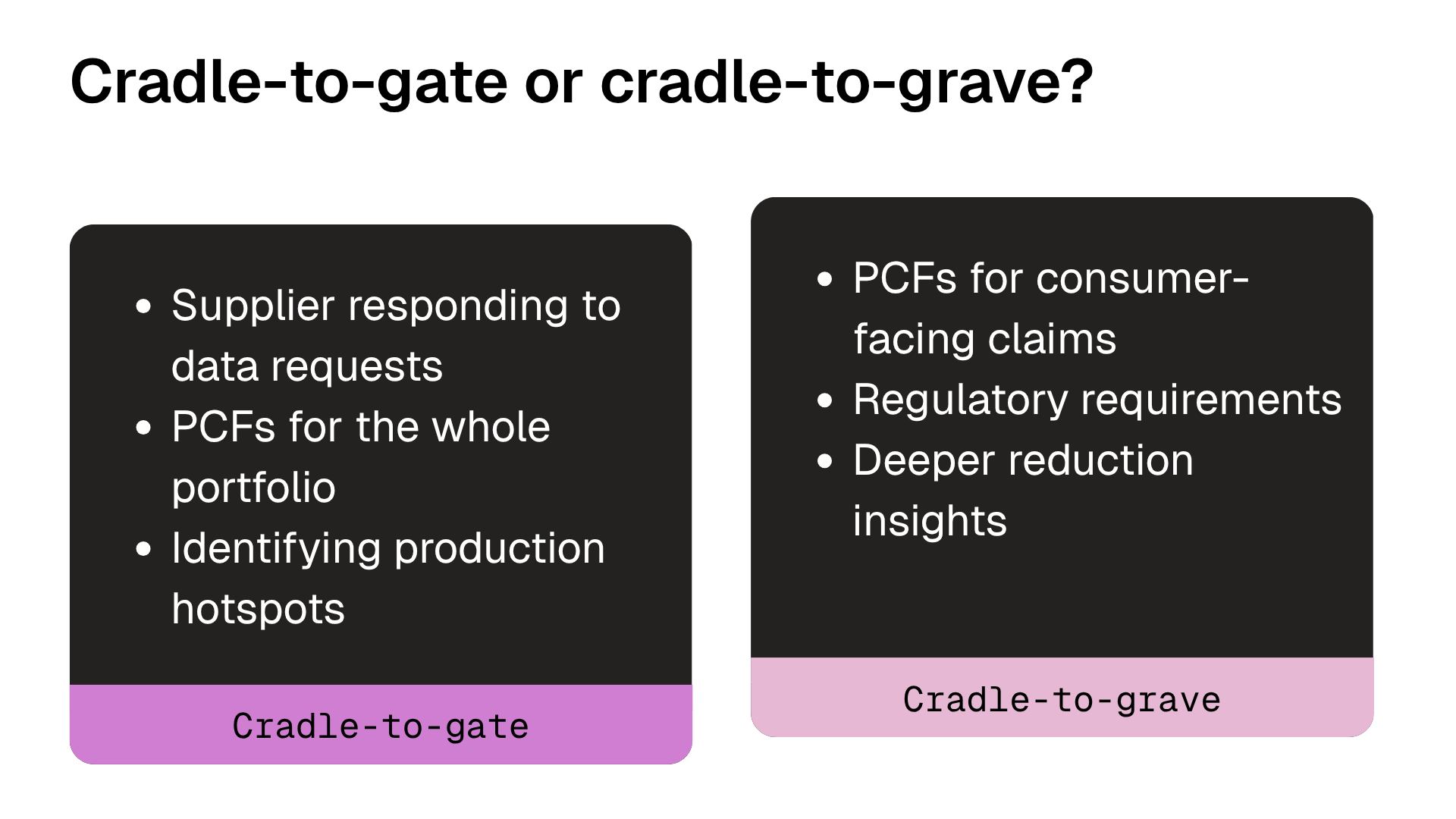
- You're a supplier responding to B2B data requests. Customers asking for scope 3 supply chain data typically need cradle-to-gate figures: the emissions embedded in the products they purchase from you.
- You need PCFs for the portfolio. Cradle-to-gate requires less data and fewer assumptions, making it possible to calculate PCFs across hundreds or thousands of products at a time.
- You want to identify production hotspots. If your goal is to understand where emissions come from in your own operations and supply chain, cradle-to-gate gives you actionable data on materials, energy, and logistics.
- You're calculating PCFs for intermediate products (e.g. steel, chemicals, components) that will be incorporated into another company's finished goods.
When to use cradle-to-grave
Cradle-to-grave is the right choice when:
- You want to prepare products for consumer-facing environmental claims. ClimatePartner requires all ClimatePartner certified products to be calculated cradle-to-grave. This is also a prerequisite for programmes like Amazon's Climate Pledge Friendly.
- You need to meet evolving regulatory requirements. Regulations increasingly want full lifecycle coverage. The CSRD's ESRS E1 standard mandates scope 3 disclosure, which in practice requires lifecycle thinking across the entire value chain; the Product Environmental Footprint (PEF) framework formalises cradle-to-grave methodology for specific product categories. Together, these create strong regulatory pressure for lifecycle coverage. However, a universal mandate for formal cradle-to-grave LCA across all frameworks does not yet exist.
- You want to unlock deeper reduction insights. Use-phase and end-of-life data can reveal emissions hotspots not available in a cradle-to-gate analysis and open entirely new decarbonisation levers.
In short: cradle-to-gate is efficient and scalable, ideal for B2B data exchange and operational insights. Cradle-to-grave is comprehensive and future-proof, essential for consumer communication and regulatory compliance.
Still unsure which boundary you need? Reach out to experts to find out more.
Inside the ClimatePartner Hub: One platform, both boundaries
Rather than forcing companies to choose between speed and completeness, the ClimatePartner Hub supports both cradle-to-gate and cradle-to-grave PCFs within a single, unified workflow.
Cradle-to-gate in the Hub: Automated PCFs, built for volume
The automated PCF tool in the ClimatePartner Hub is designed for companies that need to calculate product footprints across large portfolios quickly, credibly, and cost-efficiently.
Core capabilities:
- Template-based mass data upload: Structure your product data once, then upload and calculate up to hundreds of PCFs at a time.
- AI-driven emission factor matching: Automatically map your raw materials and logistics data to the appropriate emission factor from a database of 50,000+ activity-based factors. The system also learns from historical matches across your calculations, improving consistency and accuracy over time.
- Automated data quality scoring: Aligned with the PACT framework, so you can see exactly how robust your data is and what share is based on primary sources.
- Built-in hotspot analysis: Identify which materials, processes, or logistics routes drive the most emissions across your product range.
- Validated, shareable reports: Standards-aligned outputs that are ready for customers, auditors, and internal stakeholders after validation from ClimatePartner experts.
The tool is designed for suppliers and manufacturers who are responding to customer PCF requests, preparing for regulatory reporting, or building a carbon data foundation across their product range.
Cradle-to-grave in the Hub: Full lifecycle, fully flexible
The ClimatePartner Hub supports a flexible system boundary that lets users extend any PCF calculation from cradle-to-gate to cradle-to-grave, and back again, at any point, without losing data.
Key features:
- One calculation, two outputs: Calculate cradle-to-grave once and get both a cradle-to-gate output and a full cradle-to-grave output (for certification, labels, or consumer communication). No need to run separate calculations for different audiences.
- GHG Protocol aligned: The cradle-to-grave calculation follows the GHG Protocol Product Life Cycle Accounting and Reporting Standard, ensuring your full lifecycle PCFs are built on the most widely recognised international methodology.
- Three additional emissions categories for PCFs: Outbound logistics, use phase, and end of life.
- Reversible boundary extension: Freely toggle between cradle-to-gate and cradle-to-grave. If you revert, your downstream data is retained and simply excluded from the calculation until you extend again. No data loss, no rework.
- Unified PCF environment: All PCF calculations now happen in one place.
ClimatePartner certified and Financial climate contribution labels
Once a PCF is calculated, ClimatePartner offers two labelling pathways:
- ClimatePartner certified (CPC): A comprehensive certification requiring carbon accounting (cradle-to-grave for products), reduction targets, implemented reductions, financial contribution to climate projects, and transparent communication. This label is eligible for Amazon's Climate Pledge Friendly programme.
- Financial climate contribution (FCC): A label that allows companies to transparently show their financial support for climate projects. While cradle-to-grave is recommended, it is not mandatory for FCC.
Both labels will be conforming with EmpCo requirements, ensuring alignment with the latest regulatory standards for environmental claims. And they are backed by a unique climate-ID that gives consumers and stakeholders full transparency into the company's climate action measures.
Start where you are, build toward where you need to be
The reality is that most companies don't need to choose one system boundary forever. Cradle-to-gate is a strong, practical starting point, especially for suppliers increasing their PCF capabilities for the first time. It delivers immediate value: operational insights, cost savings, regulatory readiness, and credible data for B2B exchange.
Cradle-to-grave is where the market is heading. Standards, regulations, and customer expectations are converging on full lifecycle coverage. Companies that build their data foundations now, starting with cradle-to-gate and extending to cradle-to-grave when ready, will be best positioned to meet those demands without starting from scratch.
And with the ClimatePartner Hub, that transition is built into the platform. Calculate once, extend when you're ready, and get the outputs you need for every audience, all in one place.
The sooner you start calculating, the sooner you can start reducing. And that's where the real value lies.
ClimatePartner combines 20+ years of climate expertise with AI-powered software to help companies calculate, reduce, and communicate their PCFs. Whether you're calculating your first PCF or the entire portfolio, we’ll help you find the right approach.
Automated PCFs
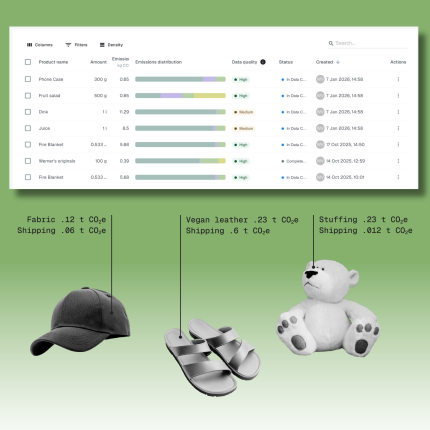
Get PCF insights in minutes, not weeks with automated product footprints. You answer customer requests faster, strengthen tenders with credible numbers, and focus reduction efforts where they matter most. Product footprints help you turn product-level emission insights into a commercial advantage – without the time and cost of manual footprints.
Find out more