Scope 3 upstream vs. downstream emissions: What’s the difference?
August 5, 2026- Scope 3 can be over 90% of a company’s total emissions. (GHG Protocol)
- Upstream emissions from manufacturing, retail, and materials sectors alone had a carbon footprint 1.4x the total EU footprint in one year. (CDP/BCG)
- More than 90% of companies don’t have scope 3 supply chain reduction targets. (EcoVadis/BCG)
What are scope 3 upstream and downstream emissions?
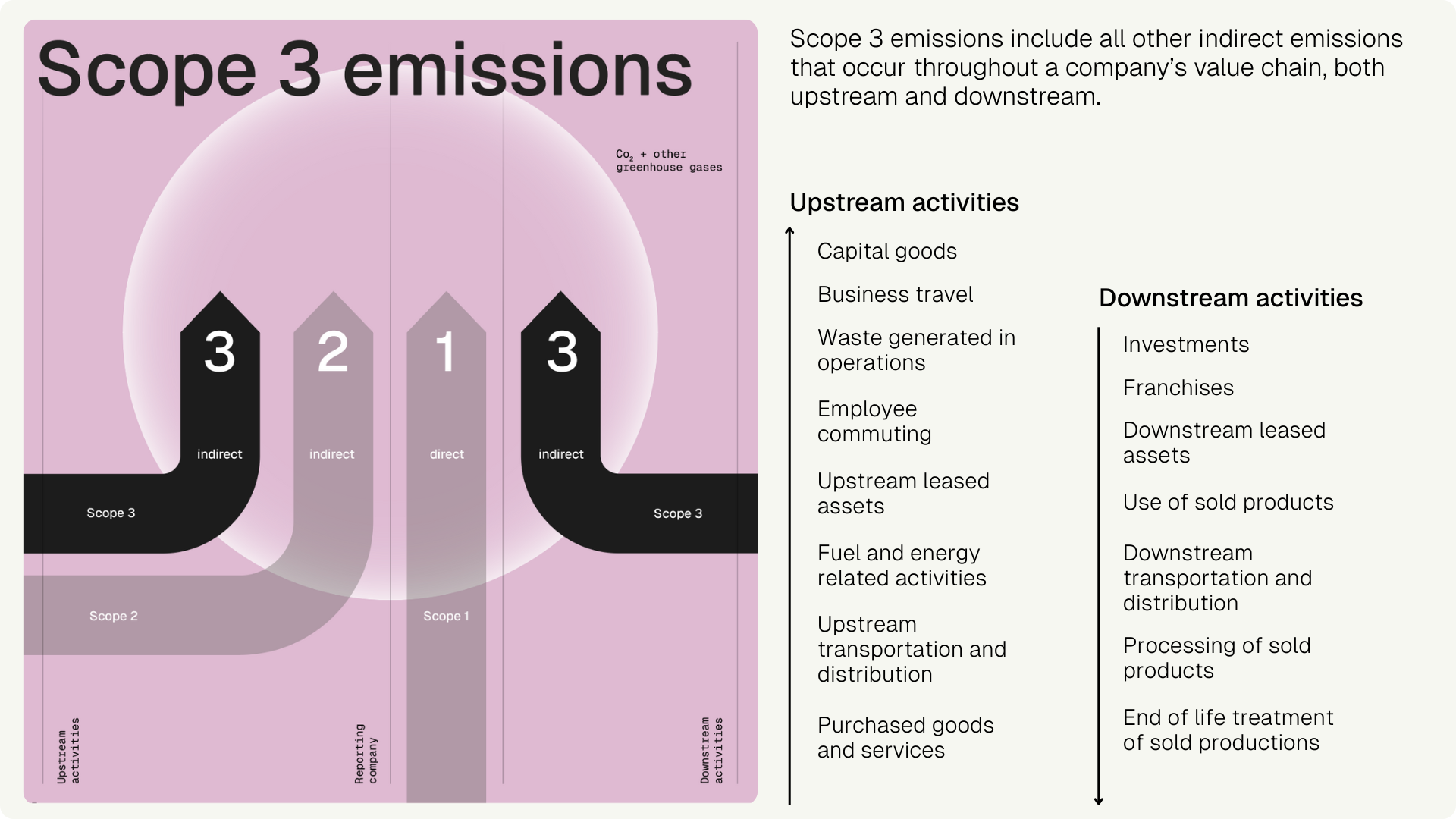
Scope 3 emissions are all indirect emissions that occur across a company's value chain that fall outside its direct operational control.
Defined by the GHG Protocol Corporate Value Chain Standard (“Scope 3 Standard”), they are divided into 15 categories and typically represent the largest portion of a company's Corporate Carbon Footprint (CCF).
The GHG Protocol splits scope 3 into two directions based on the financial transactions of the reporting company:
- Upstream emissions cover everything from raw material acquisition to delivery to your operations (often referred to as cradle-to-gate).
- Downstream emissions encompass what happens after products or services leave your control.
Understanding this split is essential for identifying emissions hotspots and prioritising decarbonisation efforts where they'll have the greatest impact. It's also increasingly required: frameworks like CSRD / ESRS reporting and science-based targets (SBTi) now require companies to calculate, disclose, and set reduction targets across their full scope 3 inventory.
What are upstream scope 3 emissions?
If you bought it, the emissions are upstream. The money flows out.
Upstream emissions, as defined by the GHG Protocol, are the indirect greenhouse gas emissions from purchased or acquired goods and services. Of the 15 scope 3 categories, upstream emissions include the first eight:
- Category 1: Purchased goods and services
- Category 2: Capital goods
- Category 3: Fuel and energy (not included in scopes 1 and 2)
- Category 4: Inbound logistics and transportation services
- Category 5: Third-party disposal of waste generated in a company's operations
- Category 6: Business travel
- Category 7: Employee commuting
- Category 8: Leased assets
If the reporting company purchases the good/service and the emissions occur before it reaches your gate, it is upstream Scope 3.
Upstream scope 3 emissions: Examples by industry
For a brand retailer, upstream emissions would come from:
- Growing and processing of cotton
- Building a new distribution centre
- Third-party shipping of fabrics from suppliers to factories
- External disposal of packaging waste
- Buyers traveling to factories for quality checks
- Store staff driving to work
- Operating a leased office
For a tech company, upstream emissions would come from:
- Micro-chip manufacturing
- Purchasing assembly line equipment
- Shipping components from a supplier to the production site
- Third-party recycling of production waste
- Engineers traveling to supplier audits
- Employees taking bus to work
What are downstream scope 3 emissions?
If someone bought it from you, the emissions are downstream. The money flows in.
Downstream emissions are related to a company’s sold goods and services. These account for the following seven categories of scope 3 emissions, according to the GHG Protocol:
- Category 9: Downstream transportation and distribution
- Category 10: Processing of sold products
- Category 11: Use of sold products
- Category 12: End-of-life treatment of sold products
- Category 13: Leased assets to other companies
- Category 14: Franchises
- Category 15: Investments
If the reporting company sells the good/service and the emissions occur after the point of sale, it is downstream Scope 3.
Downstream scope 3 emissions: examples by industry
For a car manufacturer, downstream emissions would come from:
- Shipping vehicles from the factory to the dealership
- Burning fuels over the car’s lifetime
- Scrapping vehicles (end-of-life)
- Leasing vehicles to customers
- Dealerships using energy at franchised locations
- Investing in a charging infrastructure company
For a fast-food franchisor, downstream emissions would come from:
- Delivering packaged meals to retail outlets
- Chains selling pre-made sauces further processed by food service companies
- Customers refrigerating and heating purchased food at home
- Food packaging disposal in consumer landfill waste
- Franchised locations using energy
- Investing in a food delivery start-up
Upstream vs. downstream scope 3 emissions: key differences
| Upstream Emissions | Downstream Emissions | |
| Direction | Before your operations | After your operations |
| Relates to | Purchased goods and services | Sold goods and services |
| Categories | 1–8 | 9–15 |
| Control | Emissions from sources not owned or controlled by you; occur in suppliers’ operations | Emissions from sources not owned or controlled by you; occur in customers’/users’ operations |
| Example | Raw material acquisition | End-of-life product disposal |
How to calculate upstream and downstream scope 3 emissions
Scope 3 calculations follow from the GHG Protocol Corporate Accounting and Reporting Standard as well as the more specific Technical Guidance for Calculating Scope 3.
Unlike your direct emissions, where you control the data, scope 3 relies on information from dozens or even hundreds of external partners, complex supply chains, and assumptions about product use. Companies typically face three hurdles:
- Data availability: Suppliers may not yet calculate or share their own emissions data
- Methodology choices: The GHG Protocol offers multiple calculation approaches, and choosing the right one for each category requires specialist knowledge
- Accuracy vs effort: Generic industry averages can get you started, but meaningful reduction targets require progressively more precise, supplier-specific data
Where to start
A solid scope 3 calculation begins with a screening across all relevant 15 categories to identify your emissions hotspots, where your impact is greatest, and where reductions will be most effective. From there, you can improve data quality year over year, replacing estimates with primary data from your value chain.
It's important to note that scope 3 emissions are inherently shared across value chains: one company's upstream emissions are another company's scope 1 or scope 2 emissions. The GHG Protocol acknowledges this by design; while it ensures no two companies account for the same emissions in the same scope, double counting across companies, in this case, is expected and intentional.
This is precisely why collaboration matters.
Since these emissions are shared, reducing them requires working together through supplier engagement programmes, shared decarbonisation targets, and joint investment in low-carbon solutions. Companies that engage their suppliers are nine times more likely to achieve their scope 3 reduction goals.
How to reduce upstream and downstream scope 3 emissions
Calculating your scope 3 emissions is an important first step, but the real impact comes from reducing them. Since upstream and downstream emissions occur outside your direct operations, cutting them requires a different approach than switching to renewable energy or improving building efficiency. It's about influencing, collaborating, and making smarter decisions across your entire value chain.
Reducing upstream emissions
Upstream emissions are shaped by what you buy, who you buy it from, and how it gets to you:
1. Choose lower-carbon suppliers
Not all suppliers are equal when it comes to emissions. By understanding the carbon intensity of your purchased goods and services, you can prioritise suppliers who use renewable energy, more efficient processes, or less carbon-intensive materials. Even small shifts in procurement decisions can have an outsized impact.
2. Optimise logistics and transportation
Shifting from air freight to rail or sea, consolidating shipments, or sourcing from closer suppliers can significantly reduce transport-related emissions.
3. Engage your supply chain
Many suppliers are willing to reduce their emissions, but they need a reason and a framework. Setting clear expectations, sharing knowledge, and collaborating on reduction targets creates a ripple effect through your value chain.
Reducing downstream emissions
Downstream reductions require thinking about how your products and services are used and what happens to them at end of life.
4. Design for energy efficiency:
Products that consume less energy during use, whether it's a more efficient appliance, a lighter vehicle, or software that requires less computing power. Over the product's lifetime, these savings are often much larger than the emissions from manufacturing.
5. Design for circularity:
Products that last longer, can be repaired, or are made from recyclable materials generate fewer end-of-life emissions. Circular business models, such as take-back programmes, refurbishment, or product-as-a-service, keep materials in use and out of landfills.
Reducing scope 3 emissions with ClimatePartner
Effective scope 3 reduction isn't about tackling all 15 categories at once. It starts with knowing where your biggest impacts lie and focusing your efforts where they'll deliver the greatest results. From there, it's about setting clear, science-aligned targets and building reduction into your everyday business decisions.
Having the right partner makes all the difference. Turning a complex emissions profile into a focused, actionable reduction strategy requires both deep methodological expertise and practical experience across industries and value chains.
ClimatePartner supports companies not only in calculating their value chain emissions, but in identifying the most effective reduction levers and turning climate targets into real progress.
Practical guide to scope 3.1 reduction
Scope 3.1 is the single largest line item in the corporate carbon footprint for most companies. Reducing scope 3.1 emissions is challenging, however, because they arise at suppliers, not within your own operations. This guide shows how companies can progressively shift to supplier-specific primary data, reduce scope 3.1, and integrate their supply chain into their decarbonisation strategy.
Download for free
Frequently asked questions
1: Purchased goods and services
2: Capital goods
3: Fuel- and energy-related activities (not included in scope 1 or scope 2)
4: Upstream transportation and distribution
5: Waste generated in operations
6: Business travel
7: Employee commuting
8: Upstream leased assets
9: Downstream transportation and distribution
10: Processing of sold products
11: Use of sold products
12: End-of-life treatment of sold products
13: Downstream leased assets
14: Franchises
15: Investments
Both. Scope 3 covers all indirect emissions across your entire value chain, upstream and downstream. Upstream emissions (Categories 1–8) come from your supply chain: the goods and services you purchase, transportation of materials to your sites, business travel, and employee commuting. Downstream emissions (Categories 9–15) occur after your products leave your control: their distribution to customers, use phase, and end-of-life treatment.
The key is to start with your hotspots and focus your efforts where they'll have the greatest impact. The most effective levers are:
- Smarter procurement
- Supply chain engagement
- Logistics optimisation
- Travel and commuting policies
Three main reasons:
You don't control the data. Unlike your own energy bills or fuel consumption, scope 3 relies on information from suppliers, logistics partners, and customers.
Value chains are complex. A single product can involve dozens of suppliers across multiple countries, each with different energy mixes and production methods.
Methodology requires expertise. The GHG Protocol offers multiple calculation approaches for each category, therefore choosing the right one, and the right emission factors, requires specialist knowledge to ensure credible, comparable results.
That's why many companies work with a partner like ClimatePartner to navigate the complexity and build an accurate, standards-compliant baseline they can improve over time.