Demystifying FLAG assessments
January 14, 2026By Ugne Vaitiekunaite, ClimatePartner Sustainability Expert
Forest, Land and Agriculture (FLAG) emissions account for a significant share of global GHG emissions (22%, the third highest emitting sector after energy and industry) and are critical to meeting the Paris Agreement and Science Based Targets initiative (SBTi) requirements. Even companies not directly linked to the land sector often have FLAG emissions in their supply chains and must consider them when setting science-based targets (SBTs).
Those of you who have been navigating the world of SBTs have come across FLAG emissions. While it may seem that these emissions are only relevant to companies operating in land-intensive sectors, it’s something that every business setting SBTs must consider.
Understanding the strategic importance of FLAG emissions
While conducting FLAG assessments adds complexity to the SBT-setting process, it also creates an opportunity for companies to better understand their carbon footprint and identify new reduction pathways. Although not every company will have to set a FLAG-specific target, many will need to assess just how significantly those emissions impact their footprint.
Unlike regular scope 1–3 emissions, FLAG looks into land use, agriculture, forestry, and other value‑chain activities as separate emission categories that many companies are not used to addressing. Data used in these assessments tends to be more fragmented and methodologies feel unfamiliar.
As a result, FLAG may seem as a complex, independent exercise rather than a component of your climate strategy – even though it has become a core expectation in SBT‑setting.
The methodology behind your assessment
Unless you are operating in one of the FLAG-designated sectors, it is likely that your FLAG emissions will largely be present in your supply chain, and therefore scope 3 emissions.
This also applies to businesses operating in industries which seem to have little to do with land or agriculture, as they may be purchasing FLAG-related products including paper, food, or wooden furniture.
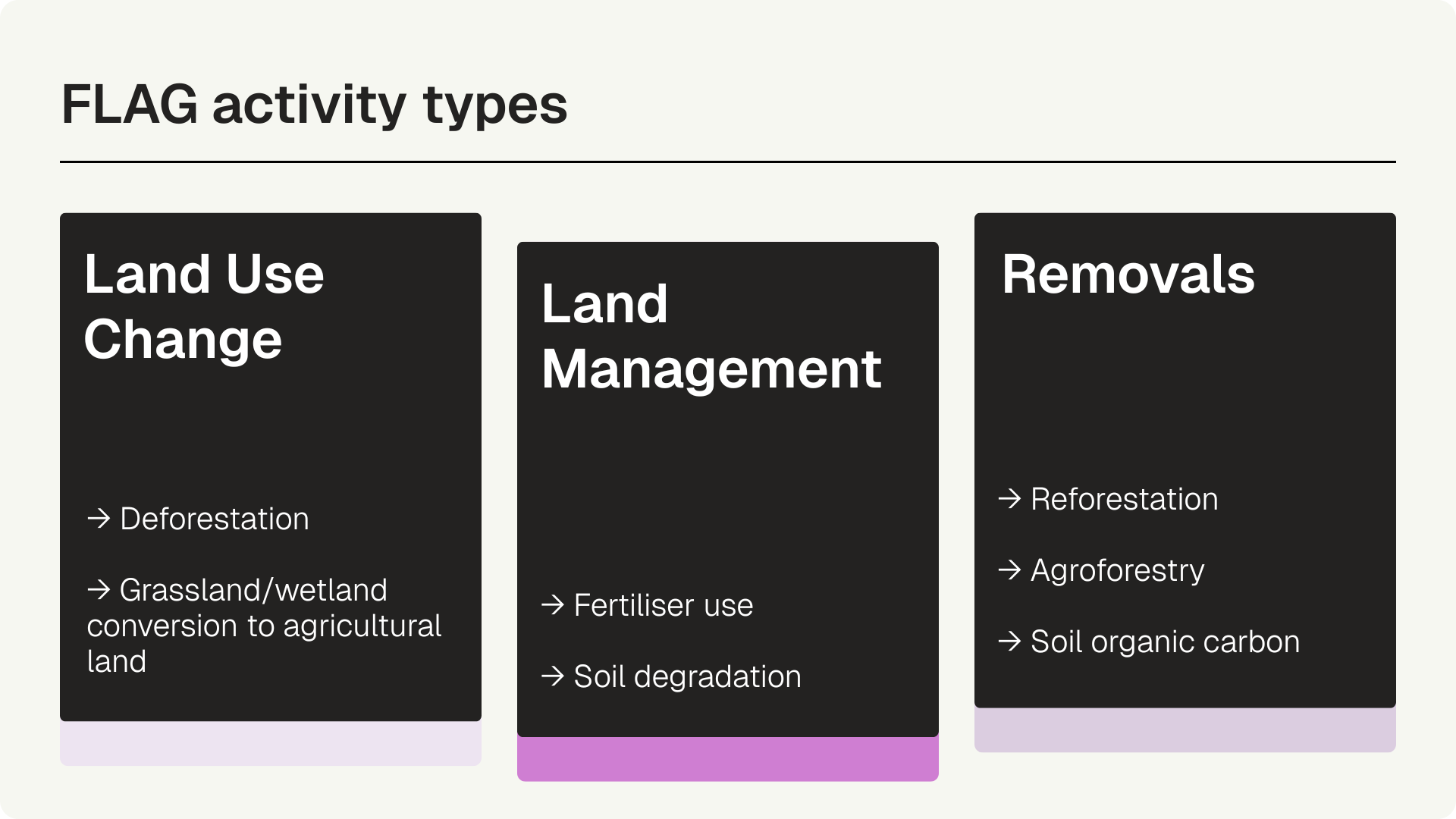
Scope 3 FLAG emissions are calculated using the same methodology as a regular carbon footprint: using activity data and supplier-specific or secondary emission factors. FLAG emissions, however, must be categorised and reported separately based on activity type:
- Land Use Change: activities that related to a change in land use, such as deforestation.
- Land Management: activities associated with fertiliser use, soil degradation, etc.
- Removals: activities related to the removal of carbon from the atmosphere and its storage (e.g., increasing soil carbon through regenerative agriculture practices).
Regular emission factors, which are much more accessible than supplier-specific emission data, cover all the above-mentioned sources and categories. However, such a granular breakdown is still largely unavailable. That is why ClimatePartner created a solution which enables automated and efficient scope 3 FLAG emissions assessments.
Simplifying FLAG for your business
ClimatePartner's approach provides an easier way to assess FLAG emissions by leveraging the data companies already collect for their carbon footprint.
Through the ClimatePartner Hub – ClimatePartner’s digital platform for carbon footprint calculations – the data is analysed and FLAG-relevant emissions are automatically identified and distinguished from other emission sources. This allows FLAG relevant emissions to be identified and calculated without manual effort. Because this approach can be applied to large datasets, companies can quickly screen their FLAG emissions and determine whether they are material enough to require a separate FLAG target and deeper analysis.
In addition, our consultants monitor SBTi and GHG Protocol developments to ensure that your assessment is up to date and translate complex methodological requirements into a clear, pragmatic approach. This combination of tools and consulting makes projects smoother and more efficient, requiring less effort from your internal teams while still delivering robust SBTi-compliant results.
FLAG requirements may add complexity, but they also unlock a deeper understanding of your value chain and new reduction opportunities. With the right support and partner, you can meet FLAG and SBTi expectations efficiently.

Guide to understanding science-based targets (SBTs)
This guide provides companies with the fundamentals of what science-based targets are, what the Science Based Targets initiative (SBTi) is, and how to get started on target-setting.
Download now